How to develop a RWA Tokenization PLlatform like Ondo Finance?
By Nexvyon Team
|May 13, 2026
|5 min read
I have spent the last several months talking to founders who want to build in the RWA tokenization space.
Most of them come in with the same question: where do we start?
They have seen the numbers. The on-chain RWA market crossed $26.4 billion in March 2026, up from $5 billion in 2022. They have read Larry Fink's annual letter where BlackRock's CEO compared tokenization today to where the internet was in 1996. They know the direction the market is moving.
What they do not have is a clear picture of what it actually takes to build a platform in this space.
So I want to be direct about what this article is and what it is not.
This is not a hype piece. This is not a market size chart with a "get in early" conclusion bolted on.
This is a breakdown of the actual build: what the layers are, what each one costs, where teams consistently get it wrong, and what a platform like Ondo Finance looks like from the inside out.
I have worked on blockchain infrastructure projects across DeFi, RWA, and crypto exchange development. The advice here comes from that experience, not from a whitepaper.
If you are seriously evaluating whether to build an RWA tokenization platform in 2026, this is the most useful starting point I can give you.
What Is Ondo Finance?
Ondo Finance is a real-world asset tokenization platform that converts traditional financial instruments into blockchain tokens. Primarily U.S. Treasury bonds and money market funds, represented as on-chain tokens that investors can hold, trade, or use as collateral in DeFi protocols. It grew from $40 million to $2.52 billion in total value locked in under two years. That growth makes it the clearest public reference for what a production-grade RWA tokenization platform looks like: the legal structure, the custodian relationships, the smart contract architecture, the multi-chain deployment, and the user-facing product all working together.Two flagship products define what Ondo built:
OUSG targets institutional investors. It is a tokenized fund holding short-term U.S. government bonds, generating yield through the underlying Treasury exposure. The token gives institutional capital the safety of U.S. government debt with the settlement efficiency of a blockchain. USDY targets a wider audience. It is a tokenized yield-bearing note backed by U.S. Treasuries, available to non-U.S. retail and institutional investors at a low minimum entry. The same underlying asset, opened to a far broader market. In September 2025, Ondo launched Ondo Global Markets, expanding from Treasury products into tokenized U.S. stocks and ETFs. International investors who previously had no practical path to U.S. equities can now hold on-chain exposure to assets like the S&P 500. The ONDO token as of April 30, 2026 trades at $0.26, with a market cap of approximately $1.28 billion. The all-time high was $2.14, reached in December 2024. Most analysts hold a cautiously bullish Ondo Finance price prediction for 2026, with a projected range of $3.50 to $5.00, though near-term price has been suppressed by large scheduled vesting releases from early investors. What Ondo teaches builders is not the product roadmap. It is the sequencing: legal and custodial infrastructure first, smart contracts second, front-end last. Teams that reverse that order consistently rebuild expensive parts of the stack.What Is an Ondo Finance Clone Script?
An Ondo Finance clone script is a pre-built, customizable software framework that replicates the core architecture of the Ondo Finance platform, giving development teams a working foundation instead of starting from zero. It is not a copy of Ondo's codebase. It is a structured starting point that mirrors Ondo's functional architecture: the token issuance and redemption logic, the KYC and whitelist gating, the yield distribution mechanism, the oracle integrations, and the admin dashboard. Here is what a properly built Ondo Finance clone script includes:- Token Contract Layer
- KYC and Compliance Module
- Yield Distribution Engine
- Oracle Integration
- Admin and Issuer Dashboard
- Investor-Facing Frontend
- Multi-Chain Bridge Module
What a Clone Script Is Not?
A clone script does not replace legal structure. The SPV, the fund formation, the regulatory filings, the custodian agreements — none of that comes with software. A clone script gives you the technical foundation. The legal and custodial layers are built alongside it, not inside it. A clone script also does not replace security audits. Every deployment of a production RWA platform needs independent smart contract audits before going live with investor funds. The script reduces development time significantly. It does not reduce audit requirements.Why Use a Clone Script Instead of Building From Scratch?
Building from scratch on a project of this complexity takes 12 to 18 months for a competent team. A well-built clone script reduces that to 4 to 6 months. The components that consume the most time in a ground-up build the compliance module, the yield distribution engine, the oracle integrations are already built and tested in the script. The customization happens at the asset class level, the compliance configuration, the chain selection, and the front-end product experience. The underlying architecture is proven. For teams with a defined asset class, a regulatory path in progress, and investor interest already established, a clone script is the fastest way to a production-ready platform.How to Build an RWA Tokenization Platform Like Ondo Finance?The 5-Layer Architecture
Building a platform like Ondo Finance is not a single engineering project. It is five distinct workstreams that need to function together before you can accept a single dollar from an investor. Here is what each layer actually involves.Layer 1 — Asset Selection and Legal Structure
This is the first decision and the most consequential one. Which assets will your platform tokenize? U.S. Treasuries, like Ondo? Real estate? Private credit? Equities? Commodities? Each asset class brings different regulatory requirements, different custodian relationships, and different investor eligibility rules. Choosing the wrong legal structure for your asset class means rebuilding it after the fact at significant cost and delay. For U.S.-based platforms, the SEC is the primary regulatory body. Token offerings to retail investors require registration or a valid exemption. Regulation D (accredited investors only), Regulation A+ (up to $75M, broader eligibility), and Regulation S (non-U.S. investors, faster to launch) are the three most common paths. Each carries different disclosure requirements, offering limits, and investor qualification checks. For European platforms, MiCA compliance is required for public token offerings in 2026. MiCA introduced a formal licensing framework for asset-referenced tokens and applies to platforms serving EU investors regardless of where the platform is incorporated. For real estate tokenization, assets are typically held inside Special Purpose Vehicles (SPVs). Tokens represent equity or debt claims on the property. Rental income or asset appreciation is distributed to token holders through smart contracts. Title companies, real estate attorneys, and property appraisers all become part of the operational structure. One important note on sequencing: the legal structure determines the smart contract architecture. Not the other way around. Transfer restrictions, investor eligibility rules, and redemption mechanics at the contract level all flow from the legal structure of the product. Teams that build the smart contracts before finalizing the legal structure consistently have to rebuild. Many first-mover RWA platforms have launched Regulation S products first targeting non-U.S. investors specifically because the regulatory path is faster and less capital-intensive. They generate revenue and track record on the Reg S product, then pursue the full U.S. retail launch as a second phase.Layer 2 — Custodian and Counterparty Relationships
The tokens are only as credible as the assets backing them. Those assets need to be held by a regulated custodian in the traditional financial system, with proper documentation, independent verification, and a clear legal chain of title from the off-chain asset to the on-chain token. Ondo's custodian relationships include State Street and Galaxy Asset Management. The involvement of institutions at that level is itself a trust signal to the market. For a real estate platform, title companies and real estate attorneys form part of the structure. For equity tokenization, broker-dealers and DTCC-connected clearing firms need to be directly involved. The custodian relationship also determines your proof-of-reserve mechanism: the on-chain verification that the tokens are fully backed. Chainlink Proof of Reserve is the most widely adopted solution for this in 2026. It provides automated, on-chain attestations that the underlying assets exist and match the outstanding token supply. Building custodian relationships takes time. Regulated financial institutions move slowly, and due diligence runs in both directions. Budget six to twelve months if you are targeting institutional-grade custody. Emerging custodians and digital asset-native firms like Anchorage Digital, BitGo, or Copper can move faster for certain asset classes.Layer 3 — Smart Contract Development
This is where the platform lives on-chain and it is the layer that most directly determines whether your platform is secure, compliant, and scalable. For an RWA platform, smart contracts handle a specific and demanding set of responsibilities: Token issuance and redemption Minting tokens when investors subscribe, burning them on redemption Yield distribution Accruing and distributing income to token holders on a defined schedule KYC and whitelist gating Ensuring only verified, eligible investors can hold or transfer tokens Transfer restrictions Enforcing jurisdiction-level compliance rules at the contract level, not just at the application layer Oracle data feeds— pulling NAV, yield rates, and proof-of-reserve attestations from off-chain sources Ondo token standards ERC-20 is the base. But ERC-20 alone is insufficient for regulated asset tokenization. ERC-3643, also known as the T-REX standard, was built specifically for compliant security token issuance. It includes native identity verification hooks and transfer restriction logic that can enforce investor eligibility checks at the contract level on every transfer. It is increasingly the institutional standard in 2026. Oracle infrastructure Chainlink provides price feeds and Proof of Reserve attestations for most major RWA platforms. Pyth Network offers higher-frequency price updates for assets requiring more rapid data refresh. Without reliable oracle infrastructure, the tokens are functionally disconnected from the real-world assets they claim to represent. Audits smart contract audits are mandatory before launch. This is not optional and it is not a formality. Production RWA contracts handle real investor capital. No unaudited contract should touch live investor funds. Budget for at least two independent audits from reputable firms Trail of Bits, OpenZeppelin, Halborn, Certora, and Quantstamp are among the most credible in 2026. Expect $30,000 to $80,000 for two thorough audits, and expect the audit process to take four to eight weeks.Layer 4 — Multi-Chain Architecture
Ondo does not operate on a single chain. It operates across Ethereum, Solana, Injective, and multiple other networks through the Ondo Bridge, built on LayerZero's cross-chain messaging protocol. The reason is straightforward: users and liquidity are distributed across chains. DeFi protocols and institutional capital concentrate on Ethereum. Speed-sensitive use cases and a fast-growing retail base live on Solana. Growing DeFi ecosystems on Arbitrum, Base, and Optimism have their own liquidity pools and user communities. A platform that only exists on Ethereum is locked out of every user and every protocol on every other chain. Cross-chain architecture significantly expands addressable market without requiring users to migrate away from their existing on-chain preferences. The practical build approach in 2026 is to launch on Ethereum mainnet first — the deepest institutional liquidity, the most mature DeFi composability, the highest trust and plan multi-chain expansion through LayerZero, Wormhole, or a comparable cross-chain protocol in phase two. For platforms prioritizing speed over depth, launching on a low-fee chain like Polygon or Arbitrum first and bridging to Ethereum later is a reasonable alternative, though it trades institutional credibility for lower operational costs in the early phase.Layer 5 — User Platform and API Layer
After the compliance infrastructure, custody relationships, smart contracts, and cross-chain architecture are in place, the user-facing platform is built on top of them. This layer includes wallet connections (MetaMask, WalletConnect, Coinbase Wallet, and institutional custody solutions like Fireblocks), portfolio dashboards showing real-time holdings and yield accrual, subscription and redemption flows, KYC onboarding integrated directly into the user journey, and fiat on-ramp and off-ramp integrations through partners like Transak, Ramp Network, or MoonPay. For retail-accessible products, the interface needs to be mobile-responsive, with a UX that guides a non-technical investor from account creation through KYC verification to their first token purchase without requiring them to understand the underlying infrastructure. The API layer serves institutional clients and DeFi protocol integrators who interact with the platform programmatically. A well-documented, reliable API layer is what allows your token to be integrated into third-party DeFi protocols, fund administrator systems, and enterprise treasury management tools. Ondo's institutional partnerships are built on this API layer.The Bottom Line
The RWA tokenization market is $26.4 billion and growing. The infrastructure is proven. The regulatory frameworks are clearer than they have ever been. Institutional capital is already committed and looking for platform partners. hat does not exist yet is the full range of platforms serving every asset class, every jurisdiction, and every investor type. Real estate tokenization at scale is early. Private credit is nascent.Commodity and carbon credit tokenization are largely unexplored. The first-mover advantage in those categories is still available. But the build needs to start with regulatory structure and smart contract architecture not a landing page.Building an RWA tokenization platform? Talk to our team.
Nexvyon builds institutional-grade RWA Tokenization Platform Development Company across DeFi and Web3. Our team covers ERC-3643 smart contract development, oracle integration, multi-chain architecture, and KYC compliance modules. Get a Free Consultation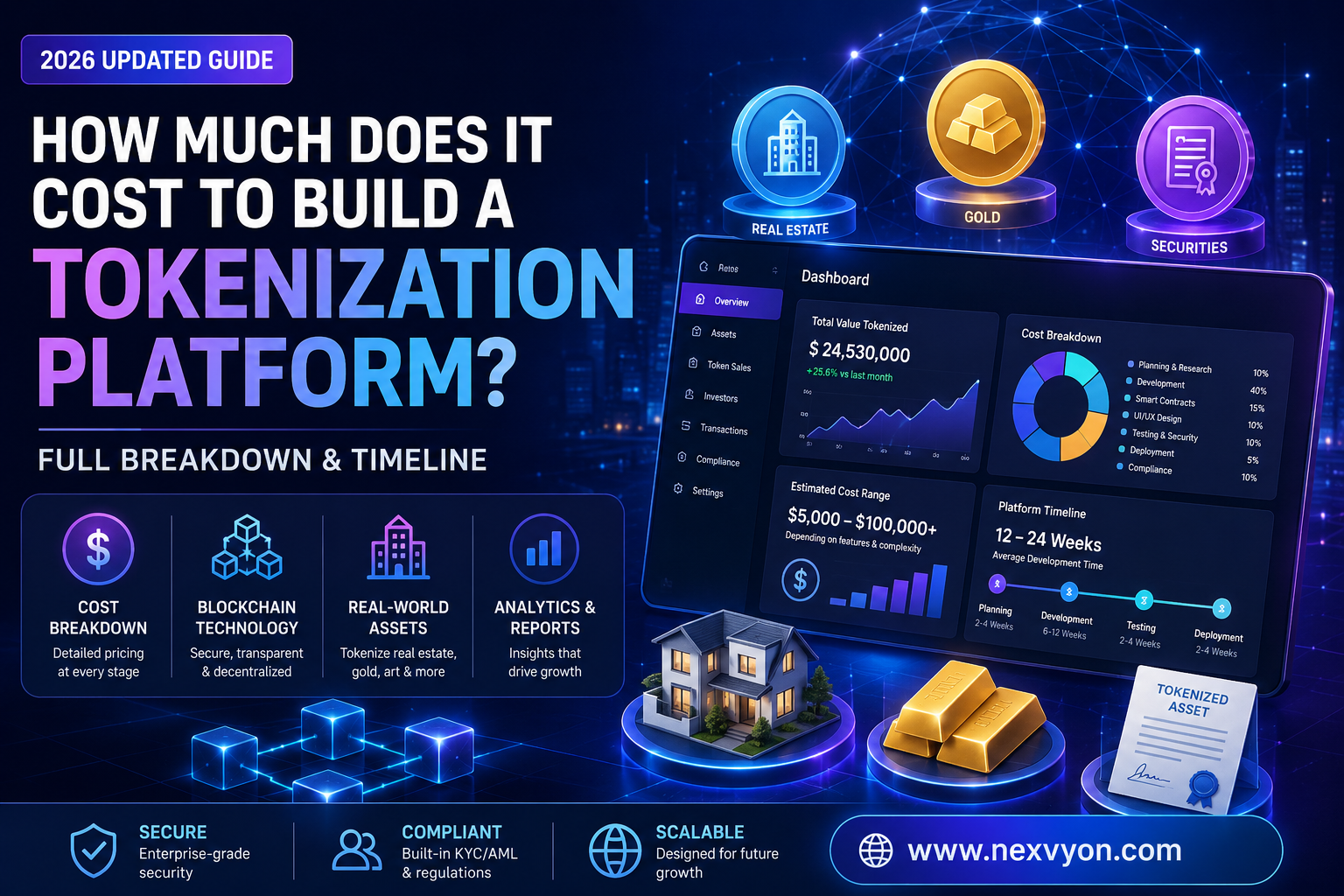
Ready to Launch Your Crypto Exchange?
Partner with Nexvyon to build a secure, scalable, and high-performance trading platform.
Get In Touch
Reach out, and let's create a universe of possibilities together!
Let’s connect
Let's align our constellations! Reach out and let the magic of collaboration illuminate our skies.
Phone
Ready to Boost Your Productivity?
Sign up now and see the difference Increasy can make for your team.